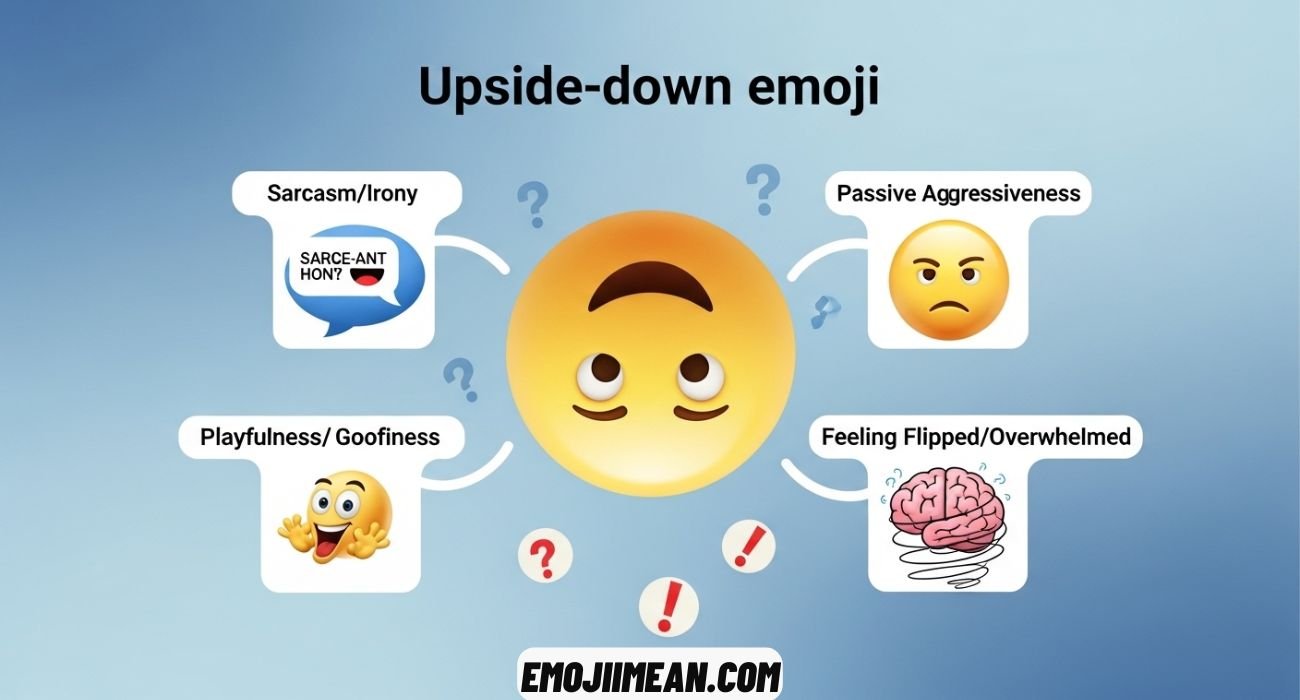
Upside Down Emoji Meaning: What It Really Says
The Upside Down Emoji Meaning shows sarcasm, joking, or playful frustration in texts. It is also called the upside down face emoji. People use it to make messages funny or to show feelings clearly. This emoji gives tone and emotion that words alone cannot show.
Have you ever got a message with 🙃 and felt confused? Many people see it and wonder what it means. It can be funny, silly, or even a little teasing. This emoji is used a lot in texting and on social media.
The Upside Down Emoji Meaning helps people understand tone in messages. It shows irony, mild annoyance, or joking in a simple way. Friends and family often use it to make chats playful. It is a popular emoji for showing feelings online clearly.
What Is the Upside Down Emoji?

The upside down face emoji was introduced in 2015 with Unicode 8.0. It is represented by a simple smiling face turned upside down, yet it is far from simple in its meaning. This emoji is designed to convey emotions that don’t fit neatly into “happy” or “sad.” It’s the emoji version of an eye-roll combined with a smile, letting the sender express feelings like sarcasm, playful frustration, or subtle annoyance.
People in the USA and across the world use this emoji in text messages, social media posts, and online chats as a form of emoji playfulness or to hint at irony. When someone sends a message like “Oh sure, waiting in line is my favorite 🙃,” the emoji sarcasm meaning is clear, even without hearing their voice. The emoji becomes a tone indicator, giving readers clues about how to interpret the message.
Unicode and Official Meaning
The Unicode Consortium is the organization responsible for standardizing emojis so they can be used across devices. According to Emojipedia, the official meaning of 🙃 is to convey silliness, sarcasm, irony, passive-aggression, or frustration masked behind a smile. Jennifer Daniel, Chair of the Unicode Emoji Subcommittee, described it as “the emoji equivalent of saying something with a smile that clearly isn’t meant to be taken at face value.”
This means that when you use the upside down emoji, you are sending subtle signals about your emotions. The emoji serves as a form of emoji language interpretation, allowing you to communicate humor, annoyance, or irony without typing an entire paragraph. In other words, the 🙃 emoji meaning is flexible and relies heavily on context, making it both fun and tricky to use in digital communication emojis.
A Linguist’s Take: Emojis Are Emotional Context Tools
Dr. Gretchen McCulloch, an internet linguist and author of Because Internet, explains that emojis like 🙃 are texting tone emojis that act as paralinguistic cues. In spoken language, tone, pitch, and facial expressions help convey meaning. In digital communication, emojis serve the same role. They are emoji conversation cues that guide how a message is read.
For example, if someone texts “I guess I’ll clean the kitchen 🙃,” the text alone may seem neutral. Adding the emoji signals a mix of playful frustration emoji and mild sarcasm. In this sense, emojis have become emoji body language, providing emotional depth to simple text messages. They can indicate humor, annoyance, or subtle emotion, turning a plain message into an ironic text message or a friendly joke.
My Take
From personal experience, I find the upside down emoji incredibly versatile. I use it to express annoyance without being harsh or to soften a joke that could otherwise be misunderstood. For instance, texting “Of course, the Wi-Fi dies right before my deadline 🙃” communicates my frustration, but in a humorous way.
In my observation, the 🙃 emoji meaning varies depending on the user and context. For friends, it might signal playful sarcasm. For a close colleague, it could be mild passive-aggression. The key is understanding emoji communication style and knowing when it’s appropriate to use this emoji in a text, email, or social media post.
How Do People Use the Upside Down Emoji?
The upside down emoji is one of the most versatile emojis in online communication. It has multiple functions and can convey a wide range of emotions depending on the context. In general, it is used to express sarcasm, irony, playful frustration, self-deprecation, mild annoyance, and sometimes flirty humor. It’s a perfect example of how social media emoji meanings have evolved to include complex emotional signals.
1. Sarcasm and Irony
People often use the 🙃 emoji to indicate sarcasm. A message like “Oh great, another Monday 🙃” is a clear signal that the sender is being ironic. In this context, the sarcastic emoji functions as a texting humor symbol, helping the recipient interpret the tone. Even without reading between the lines, the emoji adds layers of meaning that plain text cannot.
2. Playful Frustration or Helplessness
The emoji is frequently used to show minor frustrations or helplessness in a humorous way. For example, texting “Lost my keys again 🙃” turns a complaint into a lighthearted message. This is a classic example of a playful frustration emoji, showing that the sender is annoyed but still joking.
3. Self-Deprecation
Self-deprecating humor is another common use. A person might text “Told my boss ‘love you’ instead of ‘bye’ 🙃” to make fun of themselves while softening embarrassment. The self-deprecating humor emoji signals humility and humor simultaneously, making it an important emoji tone indicator in friendly chats.
4. Mock Politeness or Passive-Aggression
Sometimes, the 🙃 emoji is used to communicate passive-aggression or mock politeness. For example, “Ignored my message for three days but liked my post 🙃” subtly shows annoyance without confrontation. This is where the passive-aggressive emoji works best, providing emotional cues that would otherwise require words or context.
5. Flirting or Inside Jokes
In close relationships, the 🙃 emoji can signal playful teasing or flirtation. For instance, “Snacks and wine? You’re perfect 🙃” shows interest in a humorous way. Here, the emoji functions as a flirty emoji and a cue for inside jokes, enhancing emoji communication style between friends or partners.
When Not to Use the Upside Down Emoji

While the 🙃 emoji is fun and expressive, it is not suitable for every situation. Understanding when to avoid it is part of proper emoji etiquette and effective digital communication.
Formal Conversations
The upside down emoji should not be used in professional emails, academic discussions, or with unfamiliar people. In these contexts, the emoji can come across as flippant or disrespectful. Even when trying to be playful, the message may be misunderstood, undermining your professional tone.
Serious Situations
In emotionally sensitive situations, such as expressing sympathy or discussing serious matters, the 🙃 emoji is inappropriate. For example, texting “I’m sorry for your loss 🙃” is dismissive and could offend the recipient. In such cases, sincerity and words without emojis are critical. Using emojis incorrectly in these situations shows a lack of awareness of emotional expression online.
See Also : Brown Heart Emoji Meaning and Best Responses
Emoji Evolution: A Glimpse at Usage Stats
Emojis have become a key part of modern communication, especially among younger generations. A 2023 survey by Adobe revealed that 67% of Gen Z respondents use emojis to convey emotions more effectively than words. The upside down face emoji ranked high in expressing irony, mild annoyance, and complex emotional states.
During the pandemic, usage of the 🙃 emoji spiked as people sought to maintain lighthearted connections despite stress and isolation. Social media platforms like Instagram and Snapchat popularized its use in captions and comments, making it a staple in ironic social media posts and casual conversations. The emoji is now part of the digital language that helps Americans interpret tone, emotion, and context in everyday messaging.
| Emoji Usage Context | Common Meaning | Example |
| Sarcasm/Irony | Not serious | “Oh great, Monday again 🙃” |
| Playful Frustration | Mild annoyance | “Lost my keys 🙃” |
| Self-Deprecation | Making fun of yourself | “Told my boss ‘love you’ instead of ‘bye’ 🙃” |
| Passive-Aggression | Subtle irritation | “Ignored my text but liked my post 🙃” |
| Flirting/Inside Joke | Playful teasing | “Snacks and wine? You’re perfect 🙃” |
The table above shows how versatile the emoji is and how it functions as a texting tone emoji across multiple scenarios. It demonstrates the value of emojis as emoji conversation cues and tools for emotional expression online.
The Origins of the Upside Down Emoji
The upside down emoji was officially added to Unicode in 2015 as the upside down face emoji. Its simple design hides a complex meaning, giving users the power to convey irony, sarcasm, or playful annoyance in a single symbol. In digital communication, this small face has quickly become a tool for emoji emotional context in texting.
Over the years, its popularity grew across social media, messaging apps, and online chat platforms. People use it to subtly hint at humor or frustration, making it a classic example of emoji playfulness. Today, the 🙃 emoji is recognized worldwide as a way to communicate tone without words.
What the Emoji Really Communicates
The 🙃 emoji meaning can range from sarcasm to gentle mockery or even passive-aggression. It is a visual cue in a world of text, helping people express emotions that are difficult to convey with words alone. Think of it as a digital form of emoji body language, showing feelings in a playful or ironic way.
This emoji also allows users to express lighthearted frustration or embarrassment without offending anyone. By acting as a texting tone emoji, it softens messages and adds emotional layers, making communication richer and more expressive. It’s a key example of how digital communication emojis shape our conversations.
See Also : Current Phase of the Moon as an Emoji? A Complete USA Guide to Today’s Lunar Emoji
Sarcasm and Ironic Messages
One of the main uses of the upside down face emoji is emoji sarcasm meaning. When you write “Oh, I love getting stuck in traffic 🙃,” the emoji signals that your words are not literal. It is the perfect tool for subtle irony in ironic text messages, giving the recipient an emotional cue about your real feelings.
In social media posts, sarcastic messages often rely on emojis to prevent misunderstandings. Without the 🙃 emoji, the sarcasm could be lost, and the text might seem serious. It demonstrates how texting humor symbols help maintain clarity while adding playfulness to messages.
Expressing Playful Frustration

The playful frustration emoji is another important function of 🙃. People often use it to show minor annoyances like spilled coffee or lost keys in a humorous way. By adding this emoji, the frustration is softened, making it clear that the sender is joking rather than complaining harshly.
This use highlights the emoji’s role in emoji conversation cues, allowing subtle expression of feelings. It acts as a emoji tone indicator, helping readers understand emotions behind simple messages, which is especially useful in emojis in online chat among friends or family.
Self-Deprecating Humor and the Emoji
The 🙃 emoji is frequently used to convey self-deprecating humor. Texts like “I just spilled my lunch on myself 🙃” show humility and amusement at one’s own mistakes. This makes the emoji a useful self-deprecating humor emoji in friendly conversations and social media captions.
It allows users to laugh at themselves without sounding bitter. This emotional nuance is part of emoji emotional context, giving messages depth. Self-deprecating humor combined with the upside-down emoji creates a relatable and engaging tone in online communication.
Flirting and Inside Jokes
Flirting online often involves subtle signals, and the 🙃 emoji is perfect for this. When paired with playful messages, it can signal teasing, charm, or inside jokes, functioning as a flirty emoji in private messages or social media comments.
It also strengthens connections between friends by indicating shared humor. In this context, the emoji serves as emoji playfulness and shows emotional expression without words. Its versatility makes it ideal for creating a fun, light-hearted tone while texting or posting online.
Passive-Aggression and Mock Politeness
Sometimes, the upside-down emoji communicates mild annoyance or subtle passive-aggression. A text like “You didn’t reply for days but liked my post 🙃” signals irritation without confrontation. This is a classic example of the passive-aggressive emoji in emoji language interpretation.
The emoji provides emotional nuance that text alone cannot deliver. It allows users to convey dissatisfaction or sarcasm while maintaining a playful or ironic tone. This makes it an essential tool for reading and sending emoji conversation cues effectively.
Emoji in Professional Contexts
Despite its versatility, the upside down face emoji should be used cautiously in professional or formal contexts. Misusing it can appear flippant or disrespectful. Emails or messages to colleagues often require serious tone without emoji for jokes or ironic expressions.
Understanding emoji etiquette is important in the workplace. While the 🙃 emoji can show personality in casual chats, using it in formal emails or official communications can lead to misunderstandings and diminish credibility. Professional communication relies on clarity and proper emoji communication style.
See Also : What Does the White Heart Emoji Mean?
The Evolution of Emoji Use

The usage of the 🙃 emoji has changed over time, especially with Gen Z and social media users. Today, it is widely used in online chat to express irony, frustration, and humor. A 2023 Adobe survey found that 67% of young Americans use emojis to convey emotions better than words.
Emojis have become more than fun symbols—they are essential emoji conversation cues and tone indicators in digital communication. The emoji eye-roll, playful irony, and subtle sarcasm of the upside-down emoji illustrate how emoji use in Gen Z shapes everyday texting and social media interactions.
Tips for Using the Upside Down Emoji Effectively
To get the most out of the upside down emoji, always consider context, audience, and tone. It works best in informal chats, social media posts, and playful conversations. Overusing it can dilute its impact or confuse readers about your emoji emotional context.
Pairing the emoji with words ensures clarity, turning text into rich communication. Using it carefully enhances your emoji communication style, showing sarcasm, irony, humor, or frustration appropriately. In short, mastering the 🙃 emoji meaning is about reading the room and using it to express emotions clearly.
FAQs
What does 🙃 mean when texting?
When texting, 🙃 usually shows sarcasm, playful annoyance, or irony. It adds humor or a cheeky tone to the message.
Why is 🙃 used?
🙃 is used to convey subtle frustration, sarcasm, or playful emotions that text alone can’t express.
Is 🥰 a flirty emoji?
Yes, 🥰 is a flirty emoji that expresses affection, admiration, or romantic interest.
What does it mean when a girl says 🙃?
When a girl says 🙃, it usually signals teasing, sarcasm, or a playful mood, depending on the context.
Conclusion
The Upside Down Emoji Meaning helps people understand how to show feelings in text. This emoji shows sarcasm, playful frustration, or joking in messages. People use it to make their words funny or light. It adds emotion that text alone cannot show. Friends, family, and even social media users use it to make conversations clear and fun.
Knowing the Upside Down Emoji Meaning helps avoid mistakes in texting. It is important in messages, social media posts, and online chats. Using it the right way shows tone and feeling. People can express irony, playfulness, or mild annoyance safely. This emoji makes digital communication easy to understand and keeps conversations friendly and enjoyable.