120+ Best Replies to “All the Best” — How to Respond Gracefully Every Time
Replies to All the Best are the words you say when someone wishes you luck or success. These replies show that you are polite and thankful. They help you respond in the right way in any situation.
When someone says All the Best, you want to reply nicely. A good reply makes the other person feel appreciated. Using the right words can make you look confident and kind.
Replies to All the Best can be used at school, work, or with friends. They include short phrases like “Thank you” or “I appreciate it.” These replies make conversations smooth and friendly.
Why “All the Best” Deserves a Thoughtful Reply

At first glance, “All the best” might seem like a casual way to say goodbye or good luck. However, research shows that closing phrases carry real social meaning. When someone says “All the best,” they are signaling goodwill, support, or encouragement. Ignoring or responding awkwardly can unintentionally weaken the connection you have with that person.
According to communication studies, the way you reply to positive statements affects how your relationship is remembered. A thoughtful best response to good wishes shows that you value the person’s intent and care about the interaction. As Dr. Helen Spencer-Oatey, an expert in intercultural communication, explains, “Responses to goodwill expressions signal relational alignment, showing respect and awareness of the other person’s positive intent.”
A well-chosen All the best reply also reflects emotional intelligence. Whether in professional, academic, or personal settings, taking a moment to respond thoughtfully signals maturity, confidence, and social awareness.
Understanding the Intent Behind “All the Best”
Before you choose a response, it helps to understand what the speaker intends. “All the best” is not always the same, and context changes everything. Generally, the phrase falls into three categories. The first is genuine encouragement, often given before exams, presentations, or interviews. Someone offering support in this way expects gratitude and possibly a small acknowledgment of your preparation.
The second is a polite professional closing, common in emails, LinkedIn messages, or casual office conversation. It may not carry deep emotion but still deserves recognition. The third is a warm but neutral farewell, typical among friends, acquaintances, or informal settings, signaling kindness without strong expectations.
Recognizing these differences allows you to choose what to say when someone says all the best more accurately. A generic or careless reply may seem dismissive, while a tailored response shows attention and awareness of social nuances.
Best Replies to “All the Best” (By Context)
The best replies always match the context, tone, and relationship between the speaker and the recipient. Following a simple formula—gratitude + alignment + optional forward signal—can make your response feel natural and thoughtful.
Professional & Workplace Settings
In professional environments, your All the best reply should communicate appreciation while maintaining composure. Overly emotional replies can feel out of place, whereas brief responses may appear dismissive. Phrases like “Thank you—I really appreciate it” or “Many thanks, that means a lot” work well because they combine polite reply phrases with subtle confidence. Adding a forward-looking signal, such as “I’m looking forward to it,” reinforces professionalism and readiness.
Business communication expert Judith Humphrey notes that concise gratitude paired with forward-looking language enhances credibility without oversharing. This approach fits within professional communication tips and workplace etiquette, helping you maintain strong relationships while projecting competence.
Academic & Career Milestones
When someone says “All the best” before exams, interviews, or job transitions, they are usually expressing academic encouragement responses. Here, the ideal All the best reply balances humility with confidence. Saying “Thank you—I’ll do my best” or “Thanks, I appreciate the encouragement” acknowledges their support while reinforcing your preparation and self-assurance.
Studies show that students and professionals who respond calmly and confidently are often perceived as more prepared and professional. Using gratitude response examples in these moments strengthens relationships and leaves a positive impression, even before outcomes are known.
Email & Written Communication
Written communication requires slightly more structure. In emails or messages, replying with a single-word “Thanks” can seem abrupt. Instead, polished All the best reply options include “Thank you for your kind wishes,” “Many thanks—much appreciated,” or “Thank you. I look forward to staying in touch.”
These replies show showing appreciation in writing while maintaining email etiquette for replies. Mirror the sender’s tone: formal messages deserve formal replies, and casual messages can be slightly warmer. This approach reflects social niceties in conversation and ensures your response aligns with professional norms.
Friendly & Personal Conversations
Among friends and family, warmth is more important than polish. Responses like “Thanks—that’s really kind of you,” “Cheers! I appreciate it,” or “Thank you, fingers crossed” feel authentic and human. Casual, genuine friendly conversation responses make the other person feel valued and create a stronger emotional connection.
Using natural, conversational language in these settings ensures your All the best reply is remembered as thoughtful and kind rather than formal or rehearsed
What Not to Say (and Why)
Even well-meaning responses can misfire. Over-dismissal, like “It’s nothing” or “No worries,” can unintentionally negate goodwill. Overconfidence, such as “I don’t need luck,” can seem arrogant. And silence, especially in written communication, can appear indifferent.
Dr. Nick Morgan, a communication psychologist, emphasizes that people remember the emotional residue of interactions more than the content. A poorly judged best response to good wishes leaves a subtle negative impression. By avoiding these pitfalls, you maintain positive closing remarks and ensure your response strengthens, rather than weakens, the relationship.
Cultural Nuances: When “All the Best” Means More Than Words

While common in the U.S., the meaning of “All the best” can vary across cultures. In British and Commonwealth contexts, the phrase is warmer than “Regards” but less intimate than “Best wishes.” In cross-cultural or international workplaces, responding explicitly with polite reply phrases like “Thank you, I appreciate it” avoids misinterpretation.
Understanding these nuances is critical for professional communication tips, especially in global teams or academic collaborations. A thoughtful All the best reply ensures clarity, professionalism, and respect across different cultural expectations.
Actionable Framework: How to Choose the Right Reply Instantly
When deciding on your All the best reply, ask yourself three simple questions: Who is saying it? Is the context professional, academic, or personal? And what tone are they using? Then respond using the formula: Gratitude + Alignment + Forward Signal.
For example, in a professional email, you might say: “Thank you—I really appreciate your support and look forward to the meeting.” In a friendly text, a simple “Thanks, that’s really kind of you” works perfectly. This framework simplifies decision-making and ensures your response is always thoughtful, appropriate, and memorable.
See Also : Perfect Reply to Happy Friendship Day Wishes: Heartfelt, Funny
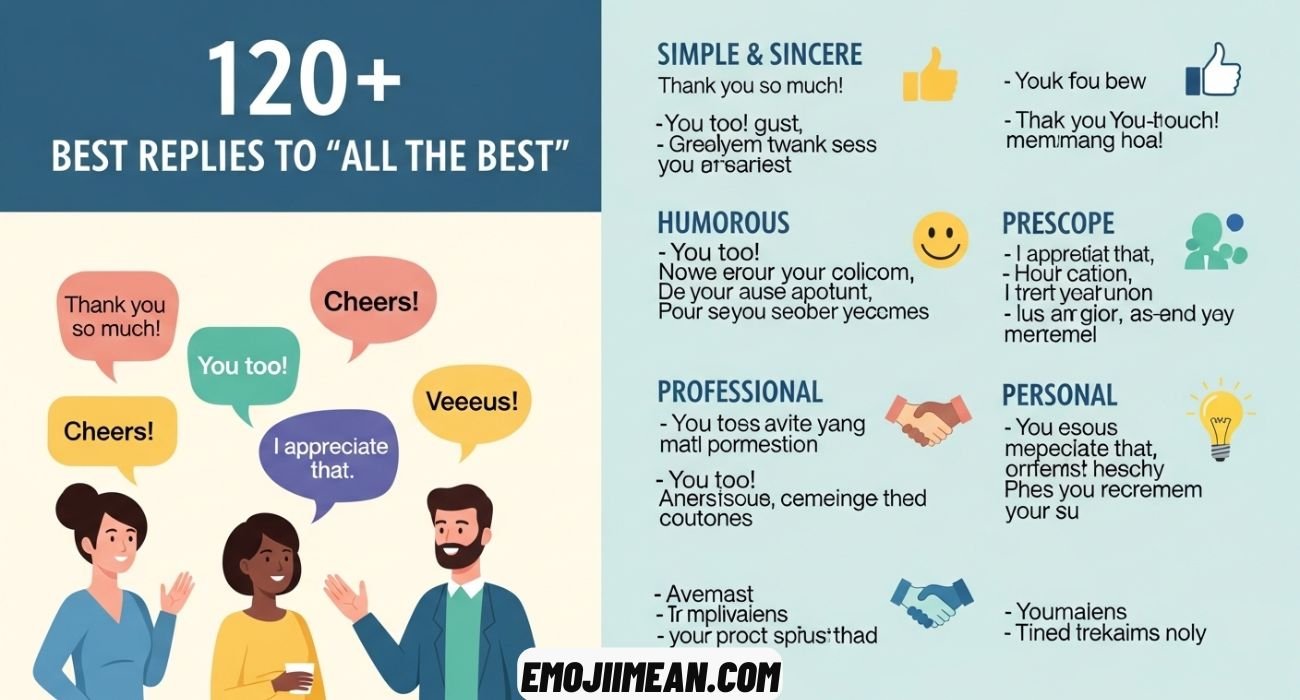
120+ Best Replies to “All the Best” — Full List
Here is a categorized list of 120+ appropriate replies to all the best, designed for U.S. readers and suitable for various contexts.
| Context | Sample Replies |
| Professional & Workplace | Thank you—I really appreciate it. / Many thanks, that means a lot. / Thanks very much. I’m looking forward to it. / Appreciate your support. / Thanks, I’ll make sure to deliver. |
| Academic & Career | Thank you—I’ll do my best. / Thanks, I appreciate the encouragement. / Feeling prepared—thank you. / Thanks, I hope it goes well. / I appreciate your good wishes. |
| Email & Written | Thank you for your kind wishes. / Many thanks—much appreciated. / I look forward to staying in touch. / Thanks for your support. / I appreciate your message. |
| Friendly & Personal | Thanks—that’s really kind of you. / Cheers! I appreciate it. / Thank you, fingers crossed. / Thanks, means a lot. / Appreciate it, good luck to you too. |
This list covers polite reply phrases, friendly conversation responses, and options suitable for professional and academic situations. You can adapt them naturally depending on the tone, relationship, and context.
How to Respond to “All the Best” Professionally
When someone says “All the best” at work, your response reflects your professional communication skills. Using polite reply phrases like “Thank you—I really appreciate it” shows respect, gratitude, and confidence. A well-chosen reply reinforces your credibility and helps you leave a strong impression with colleagues or clients.
Maintaining the right tone is critical. Responses such as “Thanks, I’m looking forward to it” or “I appreciate your support” are examples of appropriate replies to all the best. They combine gratitude with a forward-looking signal, demonstrating professionalism and awareness of workplace etiquette.
Crafting the Perfect Email Reply
Email communication requires slightly more care than spoken words. A simple “Thanks” may come across as abrupt or careless. Including gratitude response examples like “Thank you for your kind wishes” makes your email sound polished and courteous, reflecting your email etiquette for replies.
For formal exchanges, consider adding context or a forward-looking statement: “I appreciate your support and look forward to our meeting.” Such responses demonstrate thoughtfulness and align with professional communication tips, ensuring your All the best reply is remembered positively.
Responding in Academic Settings
In academic contexts, “All the best” is often a show of encouragement before exams, interviews, or presentations. A confident and humble All the best reply like “Thank you—I’ll do my best” signals preparedness and gratitude. Using such phrases helps build rapport with professors, mentors, and peers.
Another effective response is “Thanks, I appreciate the encouragement.” This demonstrates respect for the speaker’s support while reinforcing your own readiness. Combining humility and confidence is key in crafting appropriate replies to all the best in scholarly environments.
Friendly Replies Among Friends
When friends say “All the best,” warmth and authenticity matter more than formality. Simple friendly conversation responses like “Thanks—that’s really kind of you” or “I appreciate it, fingers crossed” feel natural and genuine. They strengthen social bonds and reflect social niceties in conversation.
Humor can also work in casual settings. A playful reply like “Thanks, let’s hope for the best!” adds personality while still acknowledging goodwill. The key is to maintain sincerity while keeping the tone light and relatable.
Using “All the Best” in Texts and Chats

In informal messaging, responses should feel natural and conversational. Short All the best reply phrases such as “Thanks, I appreciate it” or “Thanks, that means a lot” work well. They balance politeness with simplicity, reflecting friendly conversation responses.
Adding emojis or exclamation points can convey warmth without overcomplicating the message. For example, “Thanks! 😊” is concise yet thoughtful. Casual replies like these ensure your message matches the tone and intimacy of modern digital communication.
Avoiding Awkward Responses
Even well-meaning replies can backfire. Saying “It’s nothing” or “I don’t need luck” can seem dismissive or arrogant. Silence, especially in written communication, may appear indifferent. Understanding what to say when someone says all the best prevents awkwardness and protects relationships.
Instead, focus on a positive, thoughtful response. A reply such as “Thank you, I really appreciate your support” demonstrates gratitude and respect. Using polite reply phrases in tricky situations ensures your interactions remain smooth and professional.
Responding Across Cultures
In international settings, the meaning of “All the best” may vary. In some cultures, it is warmer than a standard “Regards” but less intimate than “Best wishes.” Using explicit All the best reply phrases like “Thank you, I appreciate it” reduces misunderstanding and shows cultural awareness.
Cross-cultural communication requires attention to tone and word choice. A thoughtful response signals professionalism and empathy. Whether in emails, meetings, or casual conversation, professional communication tips ensure that goodwill is acknowledged appropriately.
Adding Personality to Your Replies
Your All the best reply doesn’t have to be boring. Adding personal touches, such as mentioning your preparation or shared experiences, makes your response memorable. For example, “Thanks! I’ve worked hard, so I hope it goes well” combines gratitude with authenticity.
Even small adjustments like saying, “Thanks, I’ll do my best, and hope you have a great day too,” make your replies warm and relatable. Thoughtful personalization strengthens your social niceties in conversation and shows emotional intelligence.
See Also : Orange Heart Emoji Meaning and Its Responses
Responding to Multiple Good Wishes
When receiving “All the best” from several people at once, it’s important to be consistent while keeping replies genuine. Group emails or messages can include phrases like “Thank you all, I truly appreciate your support” as an appropriate reply to all the best.
For individual replies in such cases, simple variations like “Thanks, your encouragement means a lot” or “I appreciate your good wishes” show attentiveness. Balancing brevity and warmth is key to maintaining friendly conversation responses in group settings.
Building Long-Term Positive Impressions

Every All the best reply is an opportunity to reinforce relationships. Thoughtful responses leave lasting impressions, whether in professional, academic, or personal contexts. Using positive closing remarks in your replies signals respect, attentiveness, and professionalism.
Repeatedly responding with care also strengthens your network over time. Maintaining consistency in showing appreciation in writing or in speech ensures that others perceive you as polite, considerate, and confident, creating long-term benefits for your personal and professional life.
Frequently Asked Questions (FAQ)
How to respond to all the best wishes?
Simply say, “Thank you, I really appreciate it” or “Thanks, that means a lot” to show gratitude.
What if someone says all the best?
Reply with a polite All the best reply like “Thanks, I’ll do my best” or “Thank you, I appreciate your support.”
How do I reply to WSG?
WSG (What’s Good?) can be answered casually with “All good, you?” or “Hey, doing well, how about you?”
What to say back to sup?
Reply simply with “Not much, you?” or “Hey, all good, what’s up?”
Final Thoughts — Make Every Reply Count
In daily life, saying the right Replies to All the Best shows respect and kindness. Simple words like “Thank you” or “I appreciate it” make people feel valued. Using polite and friendly phrases helps you stay confident and polite in school, at home, or with friends. Good replies build trust and make conversations smooth and pleasant.Choosing the correct Replies to All the Best helps you leave a positive impression. Thoughtful answers show that you notice and care about others. Practicing these replies makes speaking and writing easier. Over time, using polite reply phrases becomes natural. Everyone notices and remembers people who respond kindly and clearly in every situation.